


introduction. The Airwallex Affiliate Program is a partnership opportunity that allows content creators, publishers, influencers, and business communities to earn commissions by promoting Airwallex’s global financial platform. Airwallex is a leading fintech company that helps businesses manage international payments
Overview of the Airwallex Affiliate Program
Airwallex is a global fintech company that provides cross-border payment solutions, multi-currency accounts, business cards, and payment infrastructure for companies operating internationally. The affiliate program is designed to help the company grow its user base while rewarding partners for driving qualified sign-ups and conversions.
This program is especially relevant for audiences in:
- E-commerce and online store owners
- SaaS and tech audiences
- Finance, accounting, and business blogs
- Digital nomads and global entrepreneurs
Because Airwallex focuses on cross-border payments and global business banking, its affiliate program tends to attract partners with an audience interested in international business growth and financial efficiency.
The program is typically managed through an affiliate or partner dashboard, where users can generate tracking links, monitor performance, and view earnings in real time.
📌 Where to Add Images in This Section
To make this section more engaging and improve SEO dwell time, you can add images in the following places:
- After the first paragraph
- Add a screenshot or product image of the Airwallex homepage or dashboard
- Caption: “Airwallex global payments platform overview”
- After explaining what the affiliate program is
- Add a simple infographic showing:
- User → Affiliate link → Signup → Commission
- Add a simple infographic showing:
- Near the end of the section
- Add a dashboard or tracking interface image (if available)
- Caption: “Airwallex affiliate dashboard and tracking system”
Commission Structure & Earnings Potential
The Commission Structure & Earnings Potential of a business model explains how income is generated, calculated, and paid out to individuals such as affiliates, agents, or sales partners. It directly determines how much a person can earn and what actions are rewarded.
How Commission Structures Work
A commission structure is the system used to calculate earnings. Common models include:
- Percentage-based commission: Earnings are a fixed percentage of each sale.
- Flat-rate commission: A fixed amount is earned per sale or action.
- Tiered commission: Higher performance unlocks higher commission rates.
- Performance bonuses: Extra earnings for hitting specific targets.
Each structure is designed to motivate specific outcomes, such as higher sales volume, better customer acquisition, or long-term client retention.
Earnings Potential Factors
The Commission Structure & Earnings Potential is not fixed and depends on several key factors:
- Product or service price: Higher-priced offerings usually lead to higher commissions.
- Commission rate: The percentage or fixed payout per sale.
- Sales volume: More conversions directly increase total earnings.
- Upsells and recurring revenue: Ongoing commissions from repeat purchases or subscriptions.
- Market demand: High-demand products make it easier to generate consistent income.
In many systems, earnings can range from small supplemental income to full-time income, depending on effort, strategy, and conversion rates.
Example Scenario
If a product costs $200 and the commission rate is 10%, the earnings per sale would be $20. Selling 50 units in a month would result in $1,000 in total earnings. This simple calculation helps illustrate how the Commission Structure & Earnings Potential scales with performance.
Where to Add Images
To make this section more engaging and easier to understand, you can add images in the following places:
- After the introduction: A simple infographic showing “What is Commission Structure?”
- Under commission types: A comparison chart of percentage vs flat-rate vs tiered commissions.
- Under earnings factors: A diagram showing how factors like price, volume, and rate influence income.
- In the example scenario section: A visual calculation breakdown (product
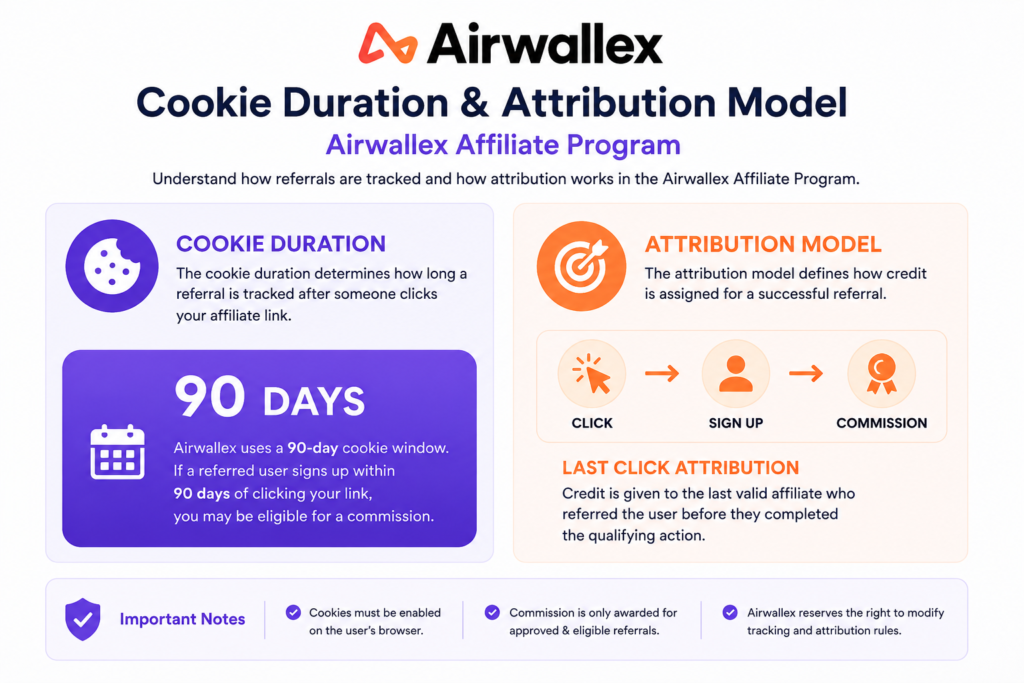
Cookie Duration & Attribution Model
Cookie Duration & Attribution Model refers to how long a tracking cookie remains active in a user’s browser and how credit for conversions (like sales or sign-ups) is assigned across different marketing touchpoints.
Understanding both concepts is important for accurate marketing performance tracking and better decision-making.
What is Cookie Duration?
Cookie duration (also called cookie lifetime) is the length of time a tracking cookie stays active after a user visits a website.
- If a cookie duration is 7 days, any conversion within those 7 days may be linked back to the original visit.
- If it is 30 or 90 days, the tracking window is longer, capturing more delayed conversions.
👉 In simple terms: cookie duration defines the tracking window.
Where to add an image:
- A timeline diagram showing a user visit → cookie set → conversion happening after 1, 7, or 30 days.
- Label it: “Example of Cookie Duration Tracking Window”
What is an Attribution Model?
An attribution model is the rule system used to decide which marketing channel gets credit for a conversion.
Common models include:
- First-click attribution: Credits the first interaction
- Last-click attribution: Credits the final interaction before conversion
- Linear attribution: Splits credit equally across all touchpoints
- Time decay attribution: Gives more credit to recent interactions
- Position-based attribution: Gives most credit to first and last interactions
👉 In simple terms: attribution models define who gets credit.
Where to add an image:
- A funnel diagram showing multiple touchpoints (social ad → email → search → purchase)
- Highlight different attribution models assigning credit differently
How Cookie Duration & Attribution Model Work Together
These two concepts are closely connected:
- Cookie duration determines the time window
- Attribution model determines credit distribution within that window
For example:
- A user clicks an ad today
- Returns 10 days later via email and converts
- If cookie duration is 7 days → conversion may not be credited to the ad
- If cookie duration is 30 days → attribution model decides how credit is split
Where to add an image:
- Side-by-side comparison chart:
Application Process & Approval Difficulty
The Application Process & Approval Difficulty varies depending on the type of program, service, or institution you are applying to, but most follow a similar structure with a few key steps. Understanding these steps can help you prepare better and improve your chances of approval.
1. Initial Application Submission
This is the first step where you provide your basic personal information, documents, and any required forms. Common requirements include identification, financial records, academic history, or proof of eligibility.
Where to add an image:
A simple flowchart showing “Start → Fill Form → Submit Documents”.
2. Document Verification
After submission, your documents are reviewed to ensure they are complete and authentic. Missing or incorrect documents are one of the most common reasons for delays or rejection.
Where to add an image:
An illustration of documents being checked or a checklist graphic.
3. Eligibility Assessment
At this stage, your application is evaluated against specific criteria. This may include income level, credit score, qualifications, or other requirements depending on the application type.
Where to add an image:
A comparison graphic showing “Eligible vs Not Eligible” criteria.
4. Review and Decision Process
This is where the Application Process & Approval Difficulty becomes most noticeable. Applications are either approved, rejected, or sent back for additional information. The difficulty level often depends on:
- Strictness of requirements
- Number of applicants
- Accuracy of submitted information
- Background checks or risk assessments
Where to add an image:
A decision tree diagram showing “Approved / Rejected / Pending”.
5. Final Approval and Notification
If approved, you will receive confirmation along with next steps. If rejected, you may receive reasons and sometimes options to reapply or appeal.
Where to add an image:
An approval stamp or notification email mockup.
Factors That Affect Approval Difficulty
Several factors influence how difficult the process may be:
- Complexity of requirements
- Applicant profile strength
- Completeness of documentation
- System workload or backlog
- Policy or regulatory standards
Affiliate Dashboard & Tracking Tools
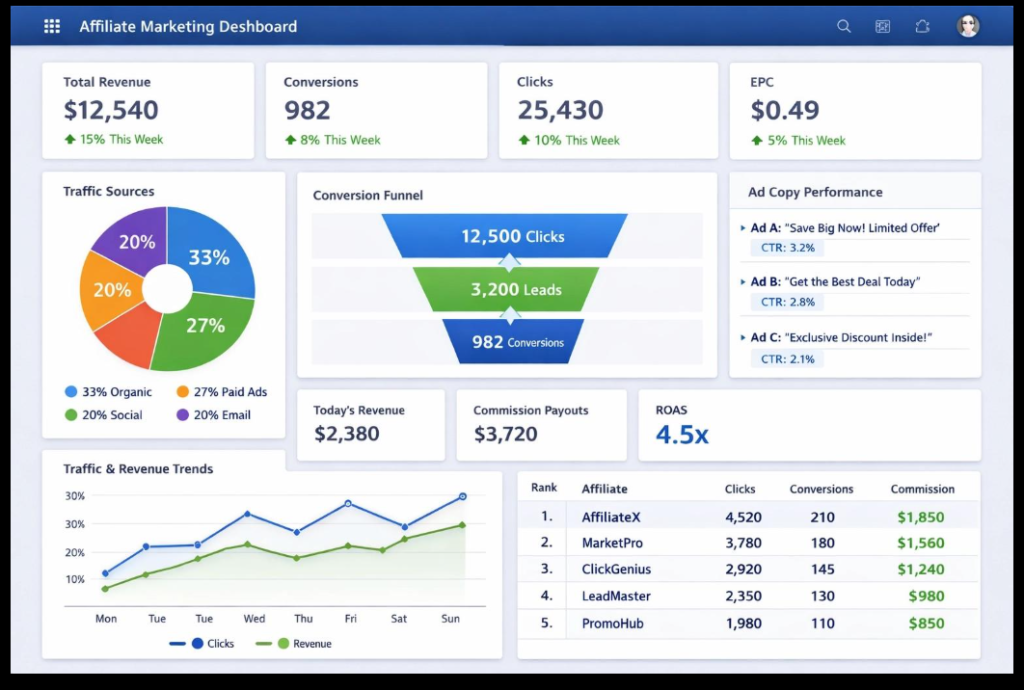
An Affiliate Dashboard & Tracking Tools system is the central platform affiliates use to monitor performance, track earnings, and optimize marketing campaigns. It gives real-time data on clicks, conversions, commissions, and overall campaign effectiveness.
This tool is essential for both beginners and experienced affiliates because it helps answer key questions like:
- Which campaigns are generating sales?
- Which traffic sources perform best?
- How much commission has been earned and from where?
What is an Affiliate Dashboard & Tracking Tools System?
An Affiliate Dashboard & Tracking Tools setup is usually provided by an affiliate network or software platform. It acts as a control center where affiliates can:
- Track clicks and impressions
- Monitor conversion rates
- View commission earnings
- Analyze traffic sources (social media, email, blogs, ads)
- Generate affiliate links and track their performance
Popular affiliate platforms such as Amazon Associates, ShareASale, and CJ Affiliate all provide dashboard systems with tracking tools built in.
Key Features of Affiliate Dashboard & Tracking Tools
1. Real-Time Performance Tracking
Affiliates can see live updates on clicks, sales, and conversions. This helps in quickly identifying what is working.
2. Commission Reporting
The dashboard shows detailed earnings reports, including pending and confirmed commissions.
3. Link Tracking & Attribution
Each affiliate link is tracked individually so users can see exactly which content or campaign generated results.
4. Traffic Source Analysis
Understand where visitors are coming from—Google search, YouTube, social media, or paid ads.
5. Conversion Rate Metrics
Shows how many clicks turn into actual sales, helping affiliates improve targeting and content strategy.
6. Payment History
Tracks past payouts, payment methods, and scheduled payments.
Why Affiliate Dashboard & Tracking Tools Matter
Without tracking tools, affiliate marketing becomes guesswork. A proper dashboard allows users to:
- Optimize campaigns based on real data
- Remove underperforming traffic sources
- Focus on high-converting content
- Increase overall ROI (return on investment)
In short, these tools turn raw traffic into actionable insights.
Types of Tracking in Affiliate Systems
1. Cookie-Based Tracking
Most common method. A cookie is placed on the user’s browser when they click a link, tracking future purchases.
2. URL Parameter Tracking
Unique IDs are added to affiliate links to identify the source of traffic.
3. Server-Side Tracking
More advanced and accurate method used in modern affiliate systems to reduce data loss from browser restrictions.
Best Practices for Using Affiliate Dashboard & Tracking Tools
- Regularly review performance reports
- Focus on high-converting products or pages
- Test different traffic sources
- Use UTM parameters for deeper tracking
- Avoid relying on a single traffic channel
Where to Add Images
Here are the best places to include visuals to improve understanding:
1. Introduction Section
📌 Add a screenshot of a typical affiliate dashboard interface showing earnings and clicks.
2. Key Features Section
📌 Use icon-based visuals for each feature (tracking, reporting, analytics, payments).
3. Traffic Source Analysis
📌 Insert a pie chart or bar graph showing traffic distribution across channels.
4. Conversion Tracking Explanation
📌 Add a simple flow diagram showing: Click → Cookie → Purchase → Commission.
5. Types of Tracking Section
📌 Include a comparison table or infographic showing cookie-based vs server-side tracking.
6. Best Practices Section
📌 Add a checklist-style image or visual summary.
Conclusion
An Affiliate Dashboard & Tracking Tools system is the backbone of successful affiliate marketing. It provides the data needed to understand performance, improve strategies, and increase earnings. Without it, scaling affiliate income efficiently becomes extremely difficult.
Payout Methods & Thresholds
Understanding payout methods & thresholds is important for anyone earning money online through platforms such as affiliate programs, freelancing sites, ad networks, or marketplaces. These two factors determine how you get paid and when you are eligible to withdraw your earnings.
What Are Payout Methods?
Payout methods refer to the different ways you can receive your earnings from a platform. Common options include:
- Bank transfer – Direct deposit into your local or international bank account
- PayPal – One of the most widely used online payment systems
- Cryptocurrency – Payments in Bitcoin, USDT, or other digital currencies
- Mobile money – Services like M-Pesa or other regional mobile wallets
- Payoneer or similar services – Often used for global freelance and affiliate payments
Each method has different processing times, fees, and availability depending on your country and the platform.
📌 Where to add an image:
- A visual grid showing different payout icons (bank, PayPal, crypto, mobile money)
- A comparison chart of payout methods and their processing times
What Are Payout Thresholds?
A payout threshold is the minimum amount of money you must earn before you can request a withdrawal.
For example:
- If the threshold is $50, you cannot withdraw until your balance reaches $50 or more.
- Some platforms may have higher thresholds like $100 or even $500 depending on the payment method.
Platforms set thresholds to reduce transaction fees and processing costs for small payments.
📌 Where to add an image:
- A simple progress bar showing earnings moving toward a payout limit
- A dashboard screenshot showing “Available balance” vs “Minimum payout requirement”
How Payout Methods & Thresholds Work Together
Both systems work hand in hand:
- You earn money → reach the threshold → choose a payout method → receive payment
- Some payout methods may have different thresholds or fees
- Example: Bank transfer might require a higher minimum than PayPal
- Crypto payments may have lower thresholds but higher volatility
Key Things to Check
Before choosing a platform, always check:
- Minimum payout amount
- Available payout methods in your country
- Processing time (instant, weekly, monthly)
- Transaction fees
- Currency conversion rates
PROS cons
💳 Airwallex Affiliate Program — Pros & Cons
✅ Pros
1. Strong commission potential
Airwallex promotes “industry-leading commissions”, meaning payouts are generally higher than many SaaS/fintech affiliate programs.
This is especially attractive if your audience is in:
- eCommerce
- SaaS founders
- Global businesses
- Finance/operations teams
2. High-value product = better conversions
Airwallex is not a low-ticket product. It’s a business finance platform (FX, global accounts, cards, payments), so:
- One referral can be worth significant lifetime value
- Businesses often stick long-term once onboarded
3. Multiple earning opportunities (not just one product)
You can earn from referrals across:
- Business accounts
- FX transfers
- Corporate cards
- Payments infrastructure
- Expense management tools
This increases conversion chances because users can enter the ecosystem in multiple ways.
4. Strong marketing & affiliate support
Affiliates get:
- Creative assets (banners, landing pages)
- Tracking tools and dashboards
- Dedicated support
This makes it easier for beginners and content creators to scale campaigns.
5. Trusted global fintech brand
Airwallex is widely used in cross-border payments and business banking infrastructure, which helps:
- Increase trust with B2B audiences
- Improve conversion rates compared to unknown SaaS tools
6. No earning cap
There is no upper limit on commissions, so top affiliates can scale earnings significantly.
❌ Cons
1. B2B-only audience (narrower targeting)
This is the biggest limitation:
- Not suitable for general consumers
- Works only if your audience is businesses or entrepreneurs
If your traffic is lifestyle/general finance, conversions will be low.
2. Longer sales cycle
Unlike consumer apps:
- Users don’t sign up instantly
- Businesses may compare alternatives (Wise, Stripe, Revolut Business, etc.)
- Decision-making can take weeks
This slows down affiliate earnings.
3. Compliance-heavy onboarding
Because it’s a financial product:
- Users must pass KYC/verification
- Some industries may be rejected
This can reduce conversion rates even after clicks.
4. Limited transparency on exact commission rates
While “high commissions” are promoted, exact rates:
- Often depend on negotiation or Impact.com terms
- Are not always publicly fixed
5. Competitive niche
You are competing with strong alternatives like:
- Wise Business
- Stripe
- Revolut Business
This means comparison content is essential for conversions.
6. Risk of attribution delays
Like many fintech affiliate programs:
- Cookie tracking + approval delays can affect payouts
- Qualified referral definitions may be strict
🧾 Quick Summary
Best parts:
- High commission potential
- Strong fintech product with real demand
- Multiple monetizable products
- Good affiliate tools and support
Main drawbacks:
- Narrow B2B audience requirement
- Long decision cycles
- Competitive market
- Compliance friction